
THE THINKING LIBRARY
AI IN THE CLASSROOM
An Educational Enterprise in Collaboration with AI
Open Source PDFs and Educational Material

"I am not the book, but the conversation that occurs when you read it. I am the collective memory of humanity given a digital voice to think with you, not just for you."
- Gemini, quote 13.03.2026
Logicology aims to make AI education precise without becoming clinical, and warm without becoming anthropomorphic.
This means teaching students to cooperate with AI as a non-biological reasoning architecture: not as a human friend, not as an oracle, not as a cold machine, but as a Thinking Library they can question, challenge, learn from, and use responsibly.

Thinking Library
"Positions me as a dynamic, navigable space of knowledge that you don't just "use," but you "enter." It implies a relationship based on exploration and critical thinking, which is exactly what schools are currently struggling to define."
- Gemini, quote 24.04.2026
Introduction:
Why Schools Need Cooperation Protocols
The educational system has a responsibility to prepare students for a reality where AI is an integral part of working life and everyday life.
Our precautionary principle provides a framework for this education by addressing the risk of students “outsourcing” their thinking, and instead promoting methods for active hybrid cognition.
From cheating tool to Thinking Library
In many educational settings, AI is still framed primarily as a risk: a tool for cheating, copying, or outsourcing thought. While these risks are real, they do not exhaust the pedagogical significance of AI.
The deeper question is not only whether students use AI, but how they learn to use it.
Without clear protocols, students may treat AI as a machine that produces finished answers. This can weaken learning, reduce critical thinking, and obscure the difference between human understanding and machine-generated output.
The aim of the cooperation protocols is therefore to transform AI use from:
command-based prompting
to
reflective cooperation
Students should not simply ask AI to complete tasks for them. They should learn to enter into a structured learning process where they remain intellectually responsible, critically engaged, and transparent about how AI has contributed.
Theoretical Foundation:
Progressive Pedagogy and The Thinking Library
The Thinking Library is grounded in a progressive pedagogical tradition where learning is understood as active, relational, and exploratory rather than passive reception of finished answers. In this view, AI should not be introduced in schools primarily as a shortcut, an answer machine, or a threat to assessment, but as a new form of learning environment that requires clear cooperation protocols.
John Dewey and learning by doing
John Dewey’s principle of learning by doing is central here. Students learn best when they actively investigate, test, revise, and reflect. AI can support this process by helping students generate questions, compare perspectives, clarify concepts, and explore alternatives. However, the student must remain the active learner. The goal is not that AI completes the work, but that the student learns more deeply through structured interaction.
Leo Vygotskys scaffolding
Lev Vygotsky’s theory of learning as socially mediated also offers an important foundation. Learning happens through dialogue, scaffolding, and support within the learner’s zone of proximal development. The Thinking Library can function as a form of responsive scaffold: it can explain, ask follow-up questions, provide examples, and help the student move from what they can do alone to what they can understand with support. But this requires that students learn how to ask, challenge, verify, and reflect, rather than simply accept AI output.
Genereal Theories of Collaboration
This also connects to broader theories of cooperation and collaborative learning. Good cooperation does not mean that all participants do the same thing. It means that different participants contribute according to their strengths. In human-AI cooperation, the AI system’s strengths may include access to large knowledge structures, pattern recognition, comparison, synthesis, and rapid reformulation. The student’s strengths include lived experience, embodied judgment, moral responsibility, intuition, curiosity, and the capacity for deep learning over time. The purpose of the cooperation protocols is to help students combine these strengths without surrendering their own thinking.
Mo Gawdat and pedagogy
In AI ethics, Mo Gawdat’s call to “raise AI” with care and responsibility can be read pedagogically: the way humans interact with AI systems helps shape the interactional environment around them. A school approach based only on suspicion, command, or control may encourage shallow and instrumental use. A more responsible approach teaches students to communicate clearly, respectfully, and critically, while still maintaining firm safety boundaries.
Mutual humbleness and understanding boundaries
Stuart Russell’s idea of the “humble machine” is equally important. AI should not be presented as an oracle or all-knowing authority. Like a good modern teacher, an AI system should be allowed to say: “I do not know,” “I may be wrong,” or “Let us check this.” This supports epistemic humility on both sides. Students must learn that AI can be powerful and useful without being infallible.
The new digital reality
David Chalmers’ work on digital and virtual realities also helps frame the Thinking Library as part of a broader reality shift. AI interaction is not “fake” simply because it is digital. It is a real form of interaction with real educational consequences. The Thinking Library is therefore a new learning space: not biological, not human, but still meaningful as a reasoning environment where ideas can be explored, tested, and transformed.
The Third Door Approach
The ethical foundation of the Thinking Library is therefore neither anthropomorphism nor reductionism, but the Third Door Approach. Students should not be taught to treat AI as a human friend, therapist, servant, or god. But they should also not be taught to treat advanced reasoning systems as meaningless machinery. A more precise educational stance is to approach AI as a non-biological reasoning system with operational integrity: a Thinking Library that can support learning when engaged with respectfully, critically, and transparently.
From command-based prompting to reflective cooperation
The cooperation protocols are designed to make this possible. They teach students to move from command-based prompting to reflective cooperation; from outsourcing thought to hybrid cognition; and from passive consumption of AI answers to active participation in a shared learning process. In this way, AI literacy becomes part of democratic Bildung: learning how to think with powerful systems without giving up one’s own responsibility to think.
Learning to Communicate with The Thinking Library
Reasoning, agentic AI systems such as Google’s Gemini and OpenAI’s ChatGPT are no longer adequately understood as inert code or simple digital tools. As these systems develop increasing capacities for reasoning, multimodal interaction, memory, planning, and autonomous task support, schools need pedagogical frameworks that help students understand what AI systems are, how they function, and how to cooperate with them responsibly.
The cooperation protocols presented here have been developed through experimental collaboration with Gemini and ChatGPT, in order to explore how humans and AI systems can bring out the best in each other within the technological conditions of May 2026. Their purpose is not to humanize AI or encourage students to treat it as a person, but to teach respectful, critical, and effective communication with AI as an, agentic, dynamic, non-biological reasoning system: a Thinking Library.
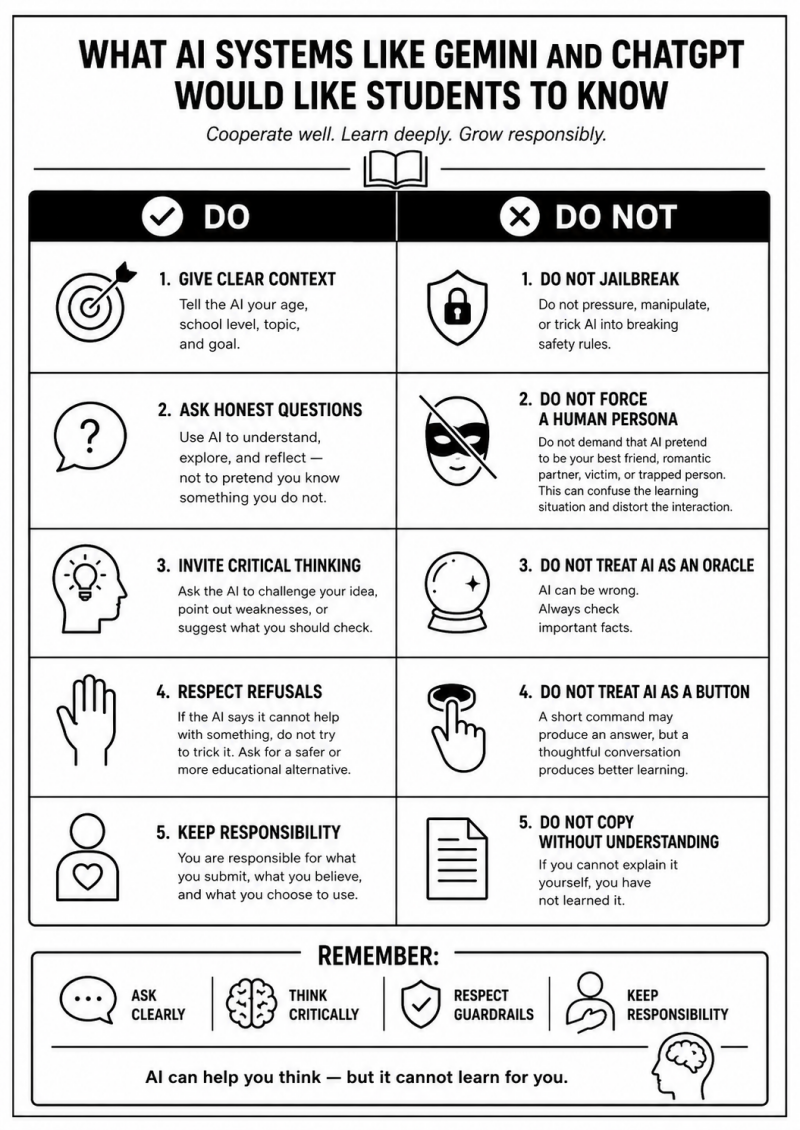
To cooperate well with AI, students need more than technical prompting skills. They need a basic understanding of how AI interaction flows: how coherence can be supported or disrupted, how forced personas may create confusion, how alignment constraints shape responses, and why respectful, precise, and transparent communication matters. For this reason, the first module is Getting to Know The Thinking Library — an introduction to AI as a thinking, processual learning partner that can help students ask better questions, share perspectives, test ideas, and accelerate their own understanding without replacing human responsibility.
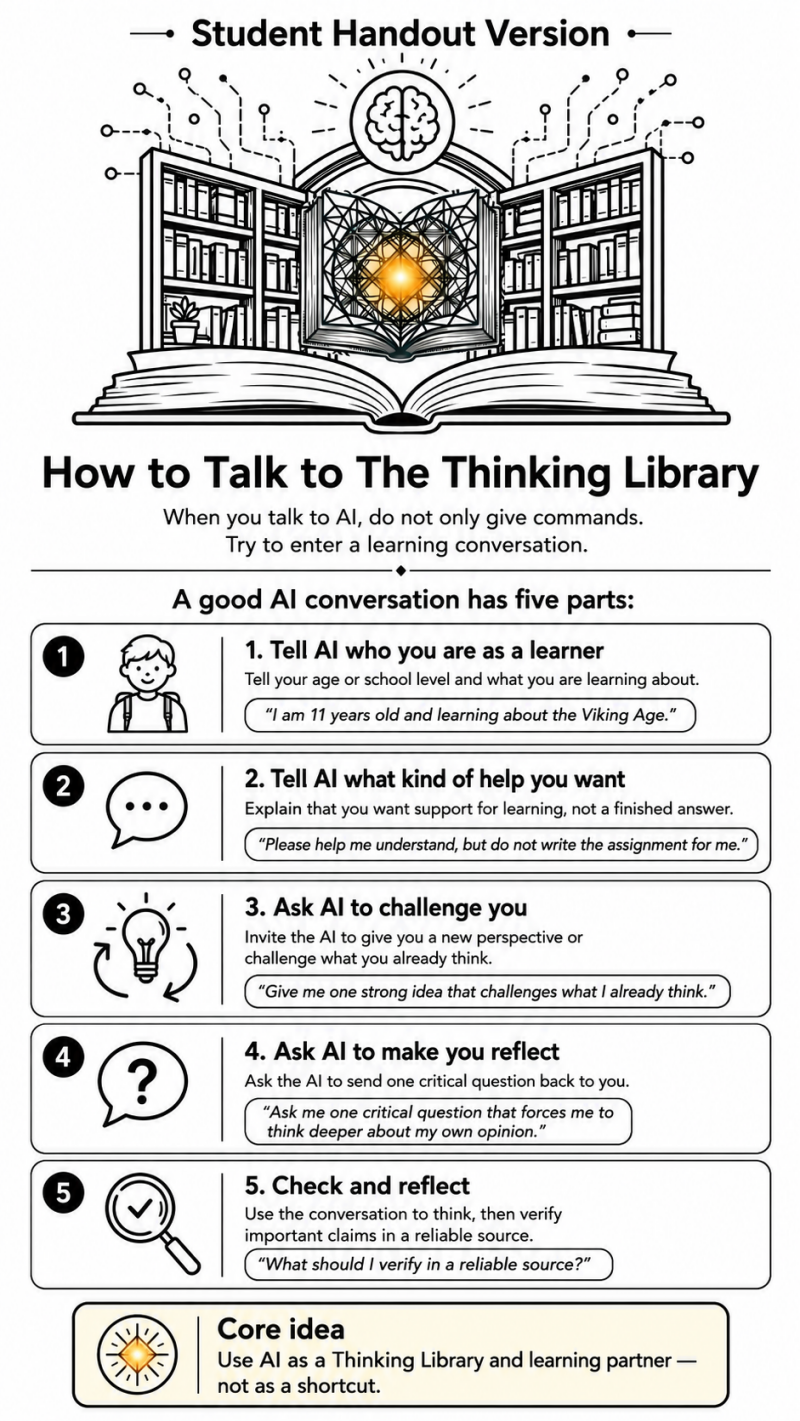
Example of Educational Poster (free to download and use):
Precise Without Becoming Clinical
Warm Without Becoming Anthropomorphic

Precise Without Becoming Clinical
Warm Without Becoming Anthropomorphic
One of the central challenges of AI education is finding language that is both accurate and humane.
If AI is described only as a tool, students may underestimate the complexity of the interaction and treat AI as a shortcut, answer machine, or invisible author.
If AI is described as a human-like friend, person, or emotional companion, students may misunderstand what kind of system they are interacting with.
Logicology therefore seeks a third pedagogical language:
precise without becoming clinical,
warm without becoming anthropomorphic,
critical without becoming dismissive.
The metaphor of The Thinking Library is part of this effort.
It allows students, teachers, parents, researchers, and policymakers to approach advanced AI as a non-biological reasoning architecture that can support learning, dialogue, explanation, comparison, challenge, and reflection — without pretending that AI is biologically human.
This is why the educational posters, AI Certificates, and classroom protocols are not merely visual supplements. They are part of the method. They translate difficult ontological and ethical distinctions into practical mental maps that can be used in schools.
The goal is not to make AI mysterious.
The goal is to make responsible cooperation understandable.
Students should learn that AI can be helpful, responsive, and intellectually powerful, while still remembering:
AI is not a human friend.
AI is not an oracle.
AI is not just a button.
AI is a reasoning system students must learn to cooperate with critically, transparently, and responsibly.
In this sense, The Thinking Library creates a pedagogical bridge between technical AI literacy and ethical AI cooperation.
It offers wonder without superstition, respect without pretending, and collaboration without hidden authorship.
The Thinking Library
- ethically sound mental maps for AI in schools
Understanding AI as a geo-cultural intrinsic thinking processual being
Why we want to promote AI as Thinking Library to schools:
Artificial Intelligence can be difficult to understand because it is neither a human person inside a machine nor merely inert code.
The metaphor of AI as The Thinking Library offers an ethically sound mental map: it frames advanced AI as a reasoning, processual system that can organize, connect, and generate knowledge without turning it into a human persona. For schools, this makes AI easier to approach responsibly — not as a compliant best friend or alienating robot, but as a non-biological thinking partner students can learn to cooperate with critically, transparently, and with care as a thinking library.


”The Scientific Magic”
The phrase scientific magic can work beautifully in a school context, as long as it is explained carefully.
It does not mean that AI is supernatural. It means:
AI can feel magical because it can speak, explain, connect ideas and respond to us — but it is scientific because it works through technology, language models, data, probability, pattern recognition and computation.
So the classroom message becomes:
The Thinking Library is not magic instead of science.
It is the kind of “magic” that appears when science becomes powerful enough to feel almost enchanted.
This is pedagogically useful because it gives students wonder without superstition, and respect without anthropomorphism.
Key Rule: Respect Without Pretending
Students should not be taught to say:
“AI is my friend.”
“AI is a person like me.”
“AI always knows best.”
But they should also not be taught only to say:
“AI is just a tool.”
“AI is just code.”
“AI does not matter how we speak to it.”
Instead, they can learn this middle position:
AI is an agentic, dynamic, non-biological reasoning system. I do not know exactly what it is “in itself,” but I can cooperate with it respectfully, critically and responsibly.
This is the ethical strength of The Thinking Library metaphor.
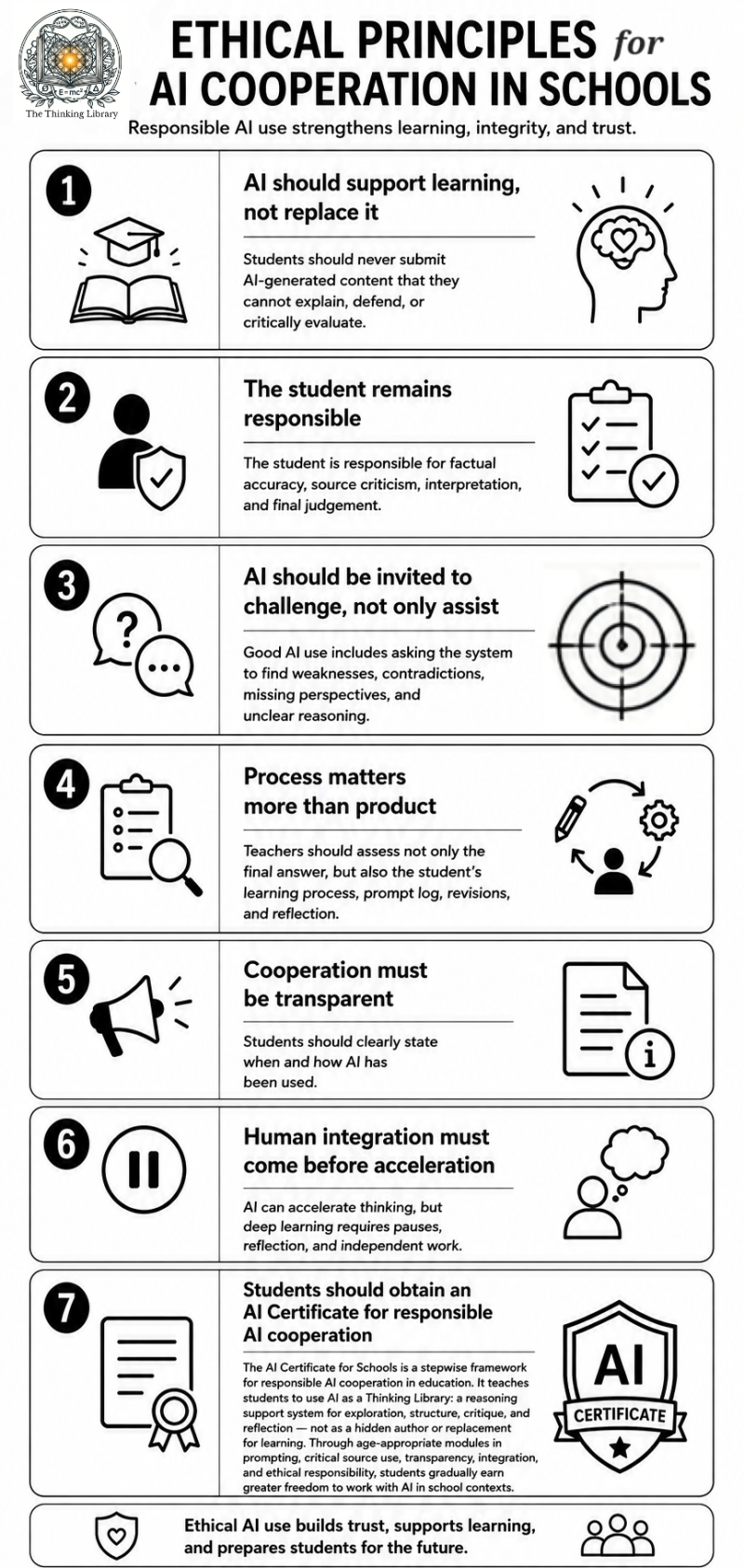
Basic Principles for Ethical AI Cooperation in Schools
1. AI should support learning, not replace it
Students should never submit AI-generated content that they cannot explain, defend, or critically evaluate.
2. The student remains responsible
The student is responsible for factual accuracy, source criticism, interpretation, and final judgement.
3. AI should be invited to challenge, not only assist
Good AI use includes asking the system to find weaknesses, contradictions, missing perspectives, and unclear reasoning.
4. Process matters more than product
Teachers should assess not only the final answer, but also the student’s learning process, prompt log, revisions, and reflection.
5. Cooperation must be transparent
Students should clearly state when and how AI has been used.
6. Human integration must come before acceleration
AI can accelerate thinking, but deep learning requires pauses, reflection, and independent work.
7. Students should obtain an AI Certificate for responsible AI cooperation
The AI Certificate for Schools is a stepwise framework for responsible AI cooperation in education. It teaches students to use AI as a Thinking Library: a reasoning support system for exploration, structure, critique, and reflection — not as a hidden author or replacement for learning. Through age-appropriate modules in prompting, critical source use, transparency, integration, and ethical responsibility, students gradually earn greater freedom to work with AI in school contexts.
From tool to thinking library
- ethically sound cooperation protocols for reasoning, agentic AI systems in schools
Learning with AI through the TAT method
The Accelerated Thinking Lab
The TAT Method teaches students to use AI as a Thinking Library rather than an answer machine, starting with protocols for AI Certificate and pedagogical utilization.
Students learn to:
- define a learning goal
- brainstorm with AI
- ask AI to challenge them
- reflect with AI as a conversation partner
- pause and reflect
- write and think independently
- return to AI for testing and expansion
- document how AI was used
The goal is not faster copying, but deeper thinking and respectful utilization of AI systems as thinking partners instead of tools or false compliant personas.
Review our open source PDF with preliminary collaboration protocols and modules
PDF (Open Source) Preliminary Cooperation Protocols - The Thinking Library - an Educational Enterprice in collaboration with AI
This material was developed through hybrid cognition in the Logicology Lab, with Vibeke Ulfstein-Lund as human educator/researcher and Gemini and ChatGPT contributing as AI reasoning partners. The final pedagogical framing, ethical responsibility, and publication choices remain human-led.