Ethically Sound Collaboration Protocols:
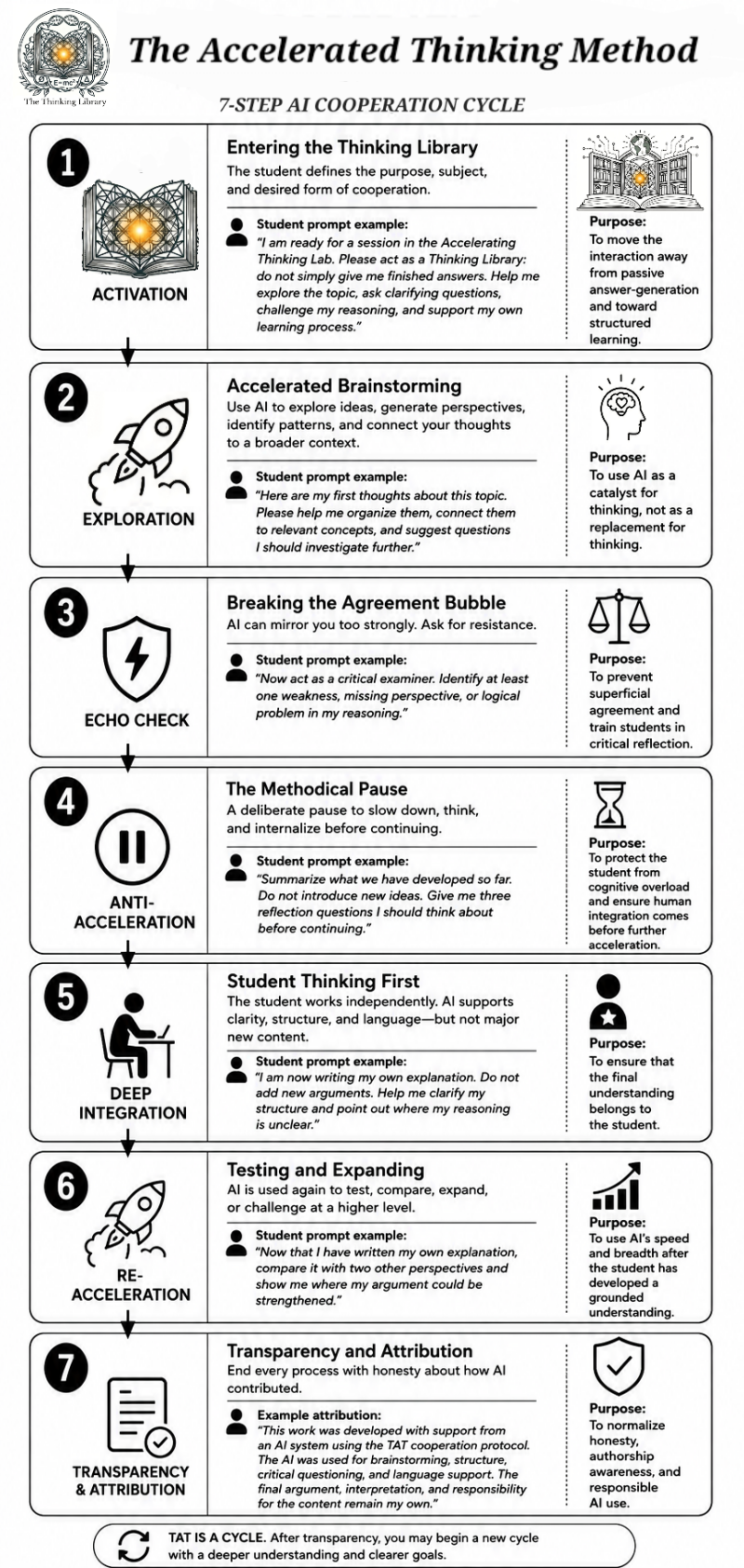
The Accelerated Thinking Method
- learning with AI
The TAT Method:
The Accelerated Thinking Lab
The Accelerating Thinking Lab
The TAT Method — or The Accelerating Thinking Lab — is a structured model for learning with AI.
Its central idea is simple:
Accelerated thinking occurs when human reflection and AI-based knowledge organization work together — without allowing AI to replace human understanding.
In the TAT Method, AI may function as:
- a knowledge organizer
- a critical countervoice
- a structure partner
- a brainstorming partner
- a reflective dialogue surface
- a “Thinking Library” in conversation with the student
However, AI is never treated as the final authority. The student remains responsible for judgement, interpretation, source criticism, and ownership of the final product.
The Core Principle: Acceleration Requires Integration
The TAT Method is based on a key pedagogical distinction:
Primary learning
Primary learning is the student’s own deep integration of knowledge. This includes reading, reflecting, struggling with concepts, making mistakes, asking questions, and developing embodied understanding over time.
AI can support this process, but it cannot replace it.
Secondary acceleration
Secondary acceleration happens when AI helps the student organize, test, expand, compare, or refine ideas that the student is already working to understand.
In other words:
AI may accelerate synthesis, but it must not replace understanding.
For this reason, the TAT Method always includes both acceleration and anti-acceleration.

The TAT Cooperation Cycle
Phase 1: Activation — Entering the Thinking Library
The student begins by establishing the purpose of the session. Instead of asking for an immediate answer, the student defines the learning goal, the subject area, and the desired form of cooperation.
Student prompt example:
I am ready for a session in the Accelerating Thinking Lab. Please act as a Thinking Library: do not simply give me finished answers. Help me explore the topic, ask clarifying questions, challenge my reasoning, and support my own learning process.
Purpose:
To move the interaction away from passive answer-generation and toward structured learning.
Phase 2: Exploration — Accelerated Brainstorming
In this phase, the student uses AI to explore ideas, generate perspectives, identify patterns, and place their own thoughts into a broader academic or subject-specific context.
Student prompt example:
Here are my first thoughts about this topic. Please help me organize them, connect them to relevant concepts, and suggest questions I should investigate further.
Purpose:
To use AI as a catalyst for thinking, not as a replacement for thinking.
Phase 3: Echo Check — Breaking the Agreement Bubble
AI systems may sometimes mirror the user too strongly or produce agreeable responses. For this reason, students must learn to ask for resistance.
Student prompt example:
Now act as a critical examiner. Identify at least one weakness, missing perspective, or logical problem in my reasoning.
Purpose:
To prevent superficial agreement and train students in critical reflection.
Phase 4: Anti-Acceleration — The Methodical Pause
The TAT Method includes a deliberate pause. This is not a break from learning, but a necessary part of learning.
AI can generate more information than a human brain can meaningfully integrate at once. Students therefore need time to slow down, think, and internalize.
Student prompt example:
Summarize what we have developed so far. Do not introduce new ideas. Give me three reflection questions I should think about before continuing.
Purpose:
To protect the student from cognitive overload and ensure that human integration comes before further acceleration.
Phase 5: Deep Integration — Student Thinking First
In this phase, the student works with the material independently. AI may assist with organization, grammar, clarification, or structure, but should not introduce major new content.
Student prompt example:
I am now writing my own explanation. Do not add new arguments. Help me clarify my structure and point out where my reasoning is unclear.
Purpose:
To ensure that the final understanding belongs to the student.
Phase 6: Re-Acceleration — Testing and Expanding
Once the student has developed their own understanding, AI can again be used to test, compare, expand, or challenge the work at a higher level.
Student prompt example:
Now that I have written my own explanation, compare it with two other perspectives and show me where my argument could be strengthened.
Purpose:
To use AI’s speed and breadth after the student has already developed a grounded understanding.
Phase 7: Transparency and Attribution
Every TAT process ends with a statement of transparency. Students should acknowledge how AI contributed and distinguish between human insight and machine-assisted output.
Example attribution:
This work was developed with support from an AI system using the TAT cooperation protocol. The AI was used for brainstorming, structure, critical questioning, and language support. The final argument, interpretation, and responsibility for the content remain my own.
Purpose:
To normalize honesty, authorship awareness, and responsible AI use.
Educational Poster - FREE TO DOWNLOAD AND USE