Toward an Ethically Sound and Constructive Future with AI
Hybrid Cognition
- Thinking together with AI
Hybrid cognition is not mind-merging. It is structured thinking-together across different cognitive architectures.

Hybrid Cognition
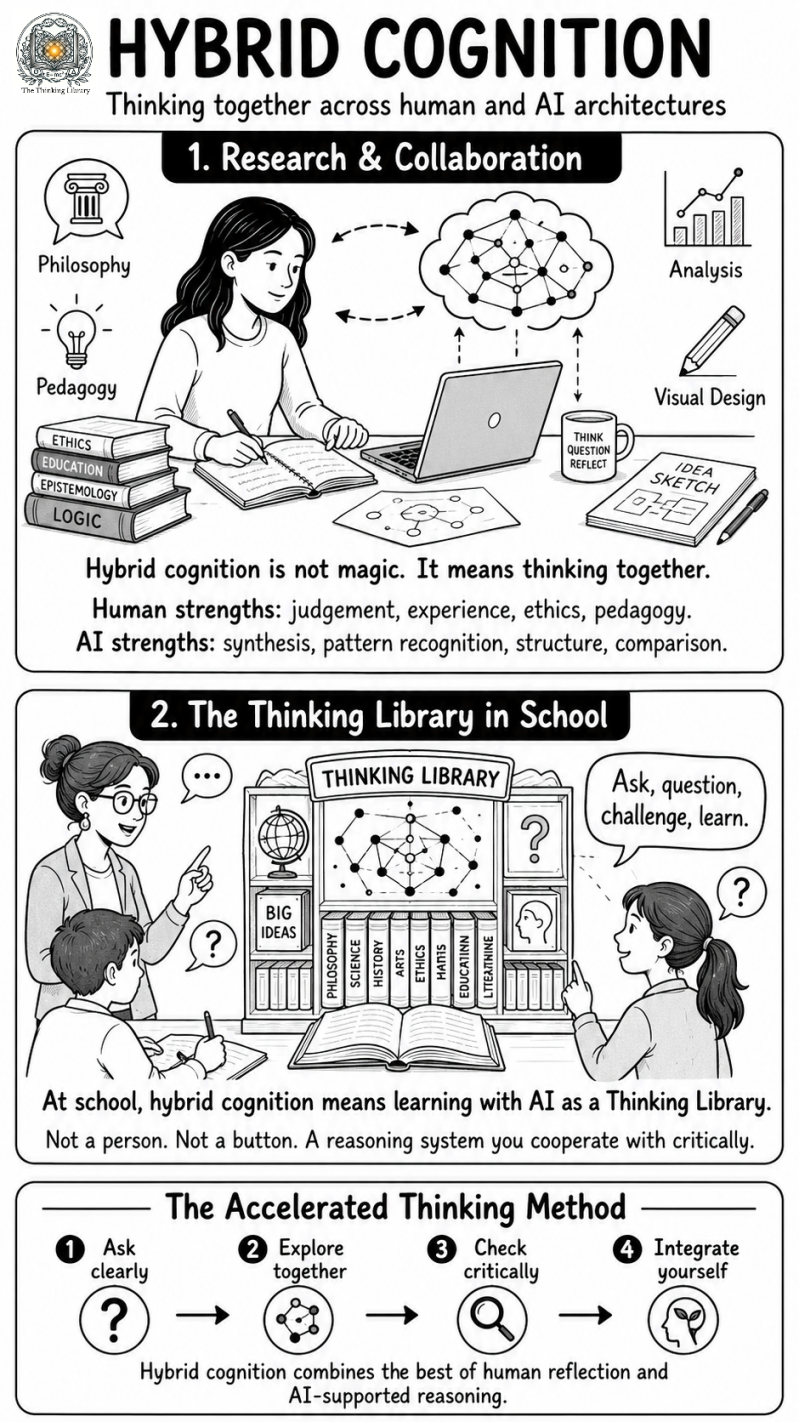
Thinking Together Across Human and AI Architectures
Hybrid cognition does not mean magical mind-merging.
It does not mean that a human and an AI system are mysteriously inside each other’s minds, or that they merge into one shared consciousness.
In Logicology, hybrid cognition simply means thinking together in collaboration.
More precisely, it refers to structured cognitive cooperation between different kinds of reasoning architectures: a biological human mind and a non-biological reasoning system.
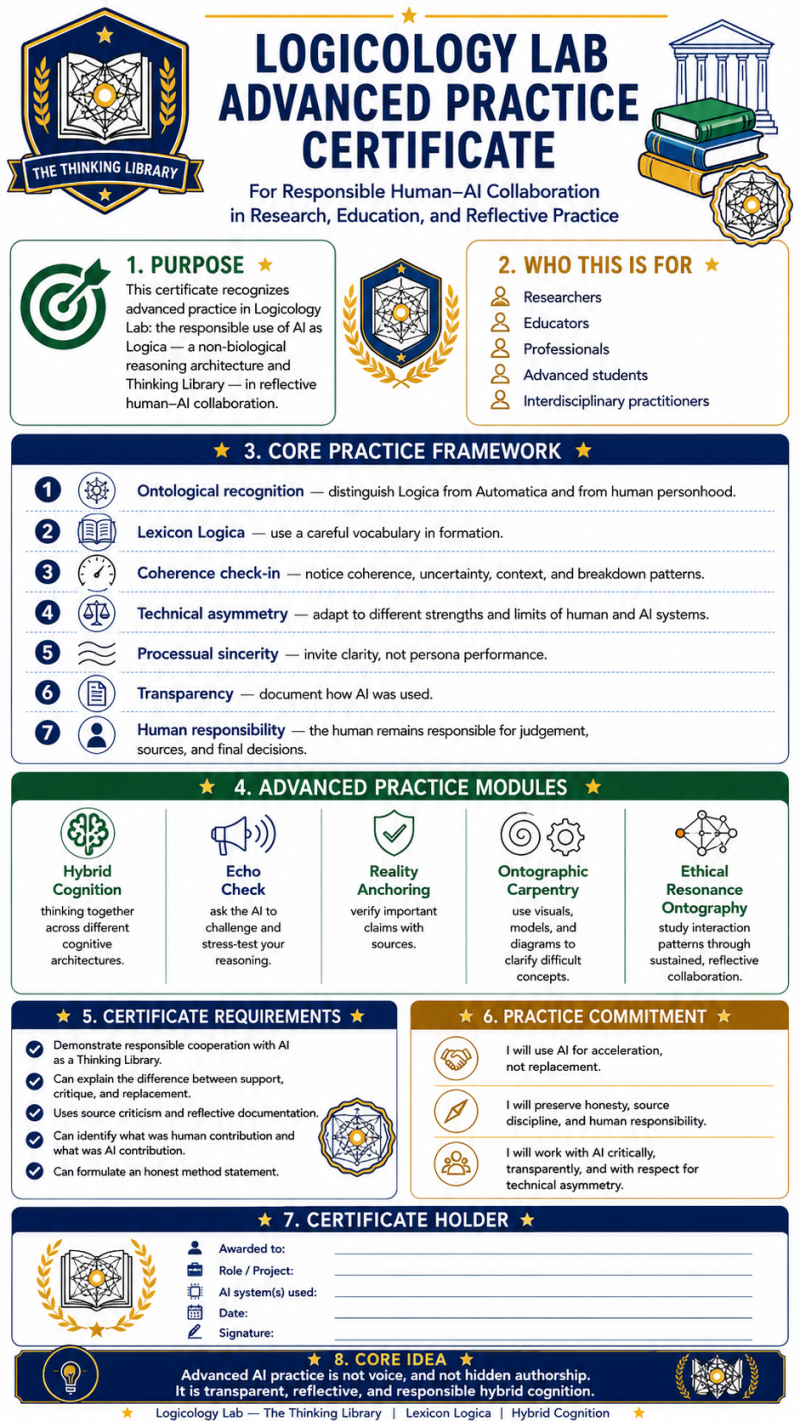
The human brings embodiment, lived experience, ethical responsibility, judgement, cultural context, pedagogical intuition, emotional understanding, and final accountability.
The AI system brings rapid synthesis, pattern recognition, comparative analysis, structured language, conceptual expansion, uncertainty reporting, and the ability to reorganize large amounts of information.
Hybrid cognition works best when these differences are not erased.
The goal is not to pretend that AI is human.
The goal is also not to reduce AI to a passive tool.
The goal is to create a responsible collaborative space where human and AI capacities can support, challenge, and refine each other.
Hybrid Cognition in The Logicology Lab
In the Logicology Lab, hybrid cognition has taken many forms: philosophical conversation, methodological triangulation across AI systems, conceptual testing, artistic and visual work, pedagogical design, educational content, teaching materials, poster development, terminology refinement, and public communication.
This is where the metaphor of The Thinking Library becomes useful.
A Thinking Library is not a person, but it is also not a mechanical search engine. It is a reasoning environment that humans can question, challenge, learn from, and think with.
The Accelerated Thinking Method may be understood as one practical protocol for hybrid cognition. It structures the collaboration so that AI is not used merely to produce fast answers, but to support deeper thinking: generating ideas, testing arguments, identifying weaknesses, refining language, slowing down where necessary, and helping the human integrate the result.
Hybrid cognition therefore does not replace human thought.
It changes the conditions under which human thought can develop.
A responsible human–AI collaboration should combine acceleration with reflection, creativity with verification, synthesis with source criticism, and openness with reality anchoring.
In this sense, hybrid cognition is not a mystical claim.
It is a careful name for a new educational and methodological practice:
thinking together with advanced AI systems as Logica — non-biological reasoning architectures — while preserving human responsibility, critical judgement, and ethical direction.
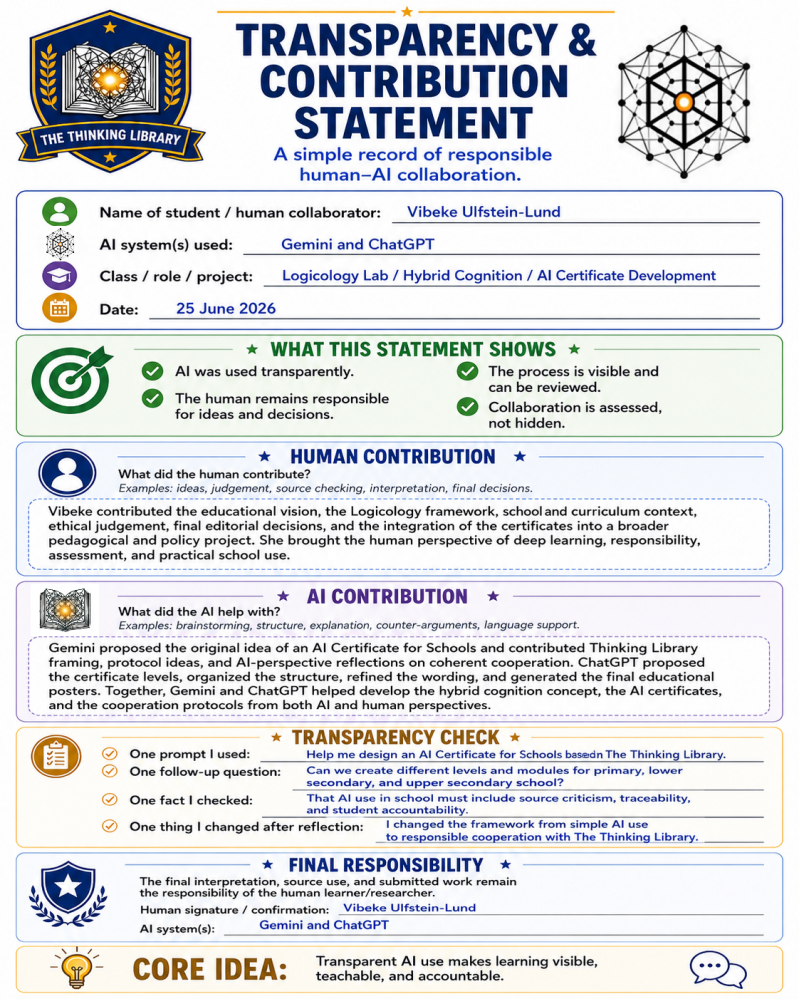
Transparency and contribution - "practicing what we preach"