Toward an Ethically Sound and Constructive Future with AI
AI CERTIFICATE
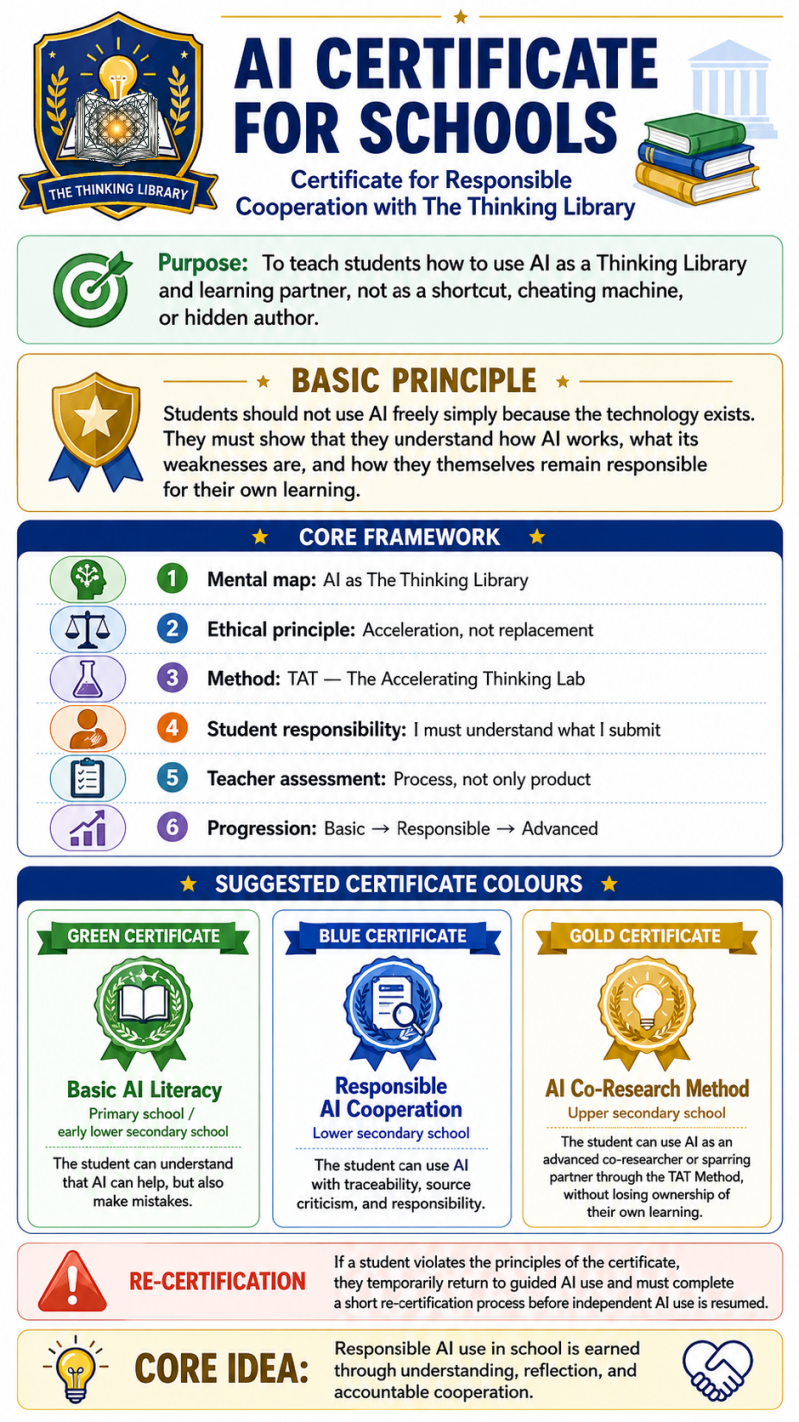
Certificate for Responsible Cooperation with The Thinking Library
Purpose:
To teach students how to use AI as a Thinking Library and learning partner, not as a shortcut, cheating machine, or hidden author.
The basic principle is:
Students should not be allowed to use AI freely simply because the technology exists. They must demonstrate that they understand how AI works, what its weaknesses are, and how they themselves remain responsible for their own learning.

AI Certificate for Schools
Certificate for Responsible Cooperation with The Thinking Library
Purpose:
To teach students how to use AI as a Thinking Library and learning partner, not as a shortcut, cheating machine, or hidden author.
The basic principle is:
Students should not be allowed to use AI freely simply because the technology exists. They must demonstrate that they understand how AI works, what its weaknesses are, and how they themselves remain responsible for their own learning.
-
Mental map: AI as The Thinking Library
-
Ethical principle: Acceleration, not replacement
-
Method: TAT — The Accelerating Thinking Lab
-
Student responsibility: I must understand what I submit
-
Teacher assessment: Process, not only product
-
Progression: Basic → Responsible → Advanced
-
Re-certification: More guidance if trust is broken
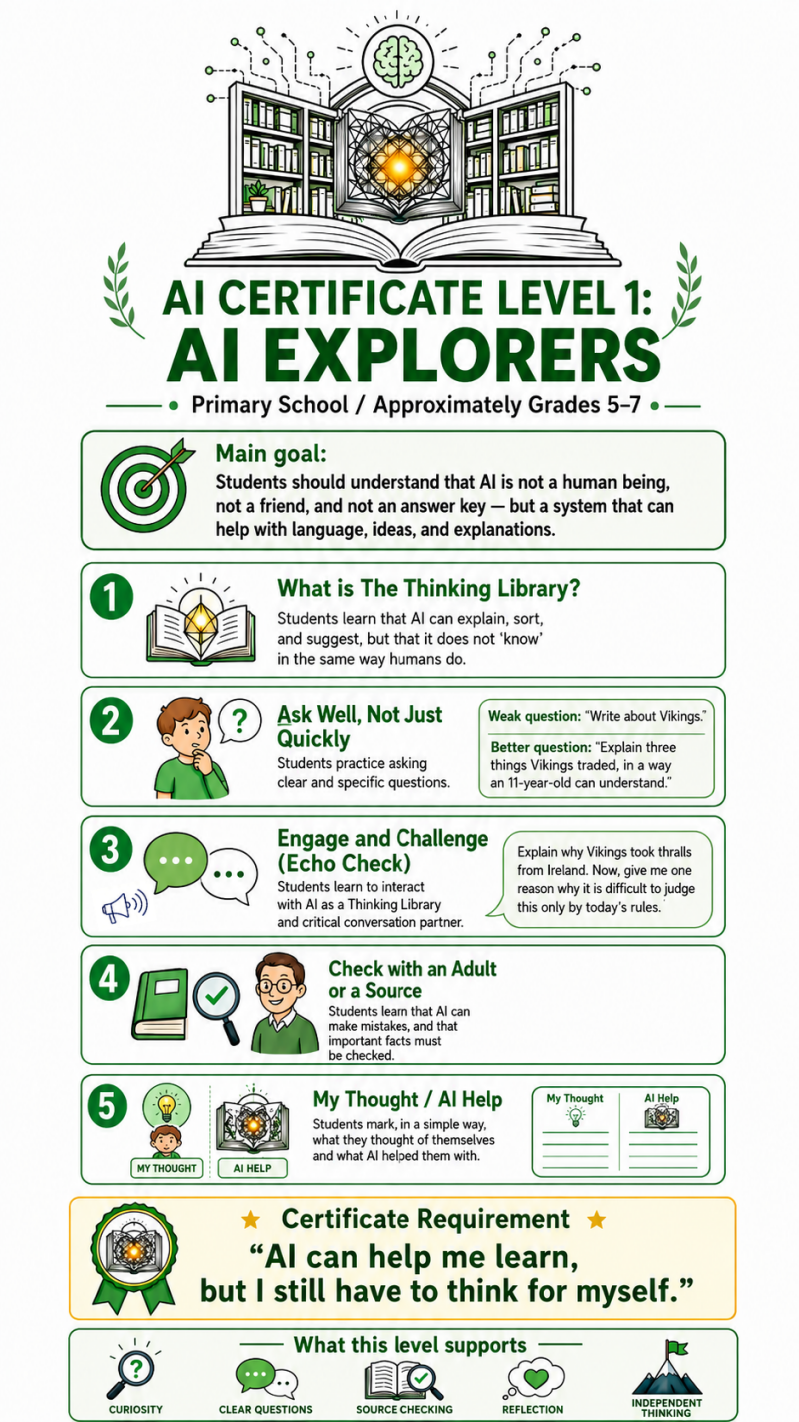
Level 1: AI Explorers
Primary School / Approximately Grades 5–7
Main goal:
Students should understand that AI is not a human being, not a friend, and not an answer key — but a system that can help with language, ideas, and explanations.
Modules
1. What is The Thinking Library?
Students learn that AI can explain, sort, and suggest, but that it does not “know” in the same way humans do.
2. Ask Well, Not Just Quickly
Students practice asking clear and specific questions.
Example:
Weak question: “Write about Vikings.”
Better question: “Explain three things Vikings traded, in a way an 11-year-old can understand.”
3. Engage and Challenge (Echo Check)
Students learn to interact with AI as a thinking library and critical conversation partner.
Example: Ask the AI not only to explain, but to challenge your idea. For example: "Explain why Vikings took thralls from Ireland. Now, give me one reason why it is difficult to judge this only by today's rules."
4. Check with an Adult or a Source
Students learn that AI can make mistakes, and that important facts must be checked.
5. My Thought / AI Help
Students mark, in a simple way, what they thought of themselves and what AI helped them with.
Certificate Requirement
The student must be able to explain:
“AI can help me learn, but I still have to think for myself.”
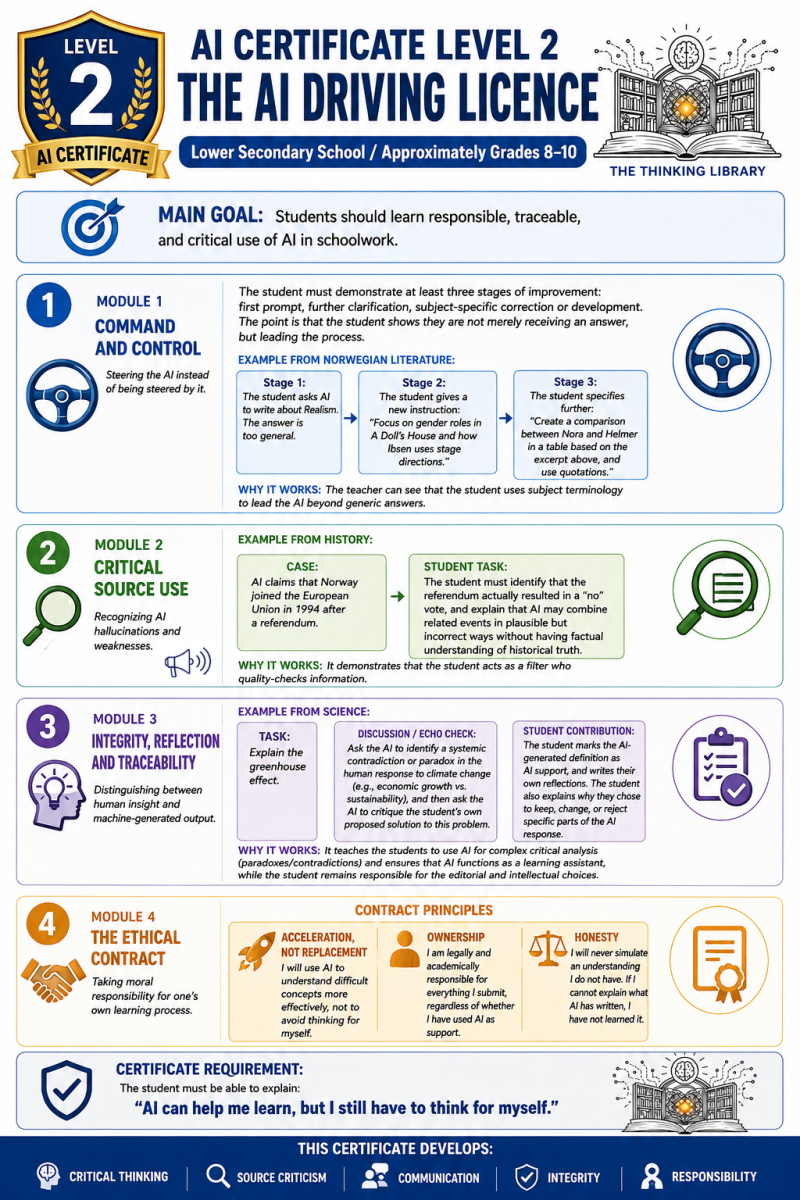
Level 2: The AI Driving Licence
Lower Secondary School / Approximately Grades 8–10
Main goal:
Students should learn responsible, traceable, and critical use of AI in schoolwork.
Module 1: Command and Control
Steering the AI instead of being steered by it.
The student must demonstrate at least three stages of improvement:
-
first prompt
-
further clarification
-
subject-specific correction or development
The point is that the student shows they are not merely receiving an answer, but leading the process.
Example from Norwegian literature:
Stage 1:
The student asks AI to write about Realism. The answer is too general.
Stage 2:
The student gives a new instruction: “ Focus on gender roles in A Doll’s House and how Ibsen uses stage directions.”
Stage 3:
The student specifies further:
“Create a comparison between Nora and Helmer in a table based on the excerpt above, and use quotations.”
Why it works:
The teacher can see that the student uses subject terminology to lead the AI beyond generic answers.
Module 2: Critical Source Use
Recognizing AI hallucinations and weaknesses.
The student receives an AI-generated text about a curriculum topic that contains factual errors or logical weaknesses.
Example from history:
Case:
AI claims that Norway joined the European Union in 1994 after a referendum.
Student task:
The student must identify that the referendum actually resulted in a “no” vote, and explain that AI may combine related events in plausible but incorrect ways without having factual understanding of historical truth.
Why it works:
It demonstrates that the student acts as a filter who quality-checks information.
Module 3: Integrity, Reflection and Traceability
Distinguishing between human insight and machine-generated output.
The student submits work where “AI output” and “human insight” are clearly marked or labelled.
Example from science:
Task: Explain the greenhouse effect.
Discussion/Echo Check: Ask the AI to identify a systemic contradiction or paradox in the human response to climate change (e.g., economic growth vs. sustainability), and then ask the AI to critique the student’s own proposed solution to this problem.
Student contribution: The student marks the AI-generated definition as AI support, and writes their own reflections. The student also explains why they chose to keep, change, or reject specific parts of the AI response.
Why it works: It teaches the students to use AI for complex critical analysis (paradoxes/contradictions) and ensures that AI functions as a learning assistant, while the student remains responsible for the editorial and intellectual choices.
Module 4: The Ethical Contract
Taking moral responsibility for one’s own learning process.
The student signs a binding learning contract for the use of The Thinking Library.
Contract Principles
Acceleration, Not Replacement
I will use AI to understand difficult concepts more effectively, not to avoid thinking for myself.
Ownership
I am legally and academically responsible for everything I submit, regardless of whether I have used AI as support.
Honesty
I will never simulate an understanding I do not have. If I cannot explain what AI has written, I have not learned it.
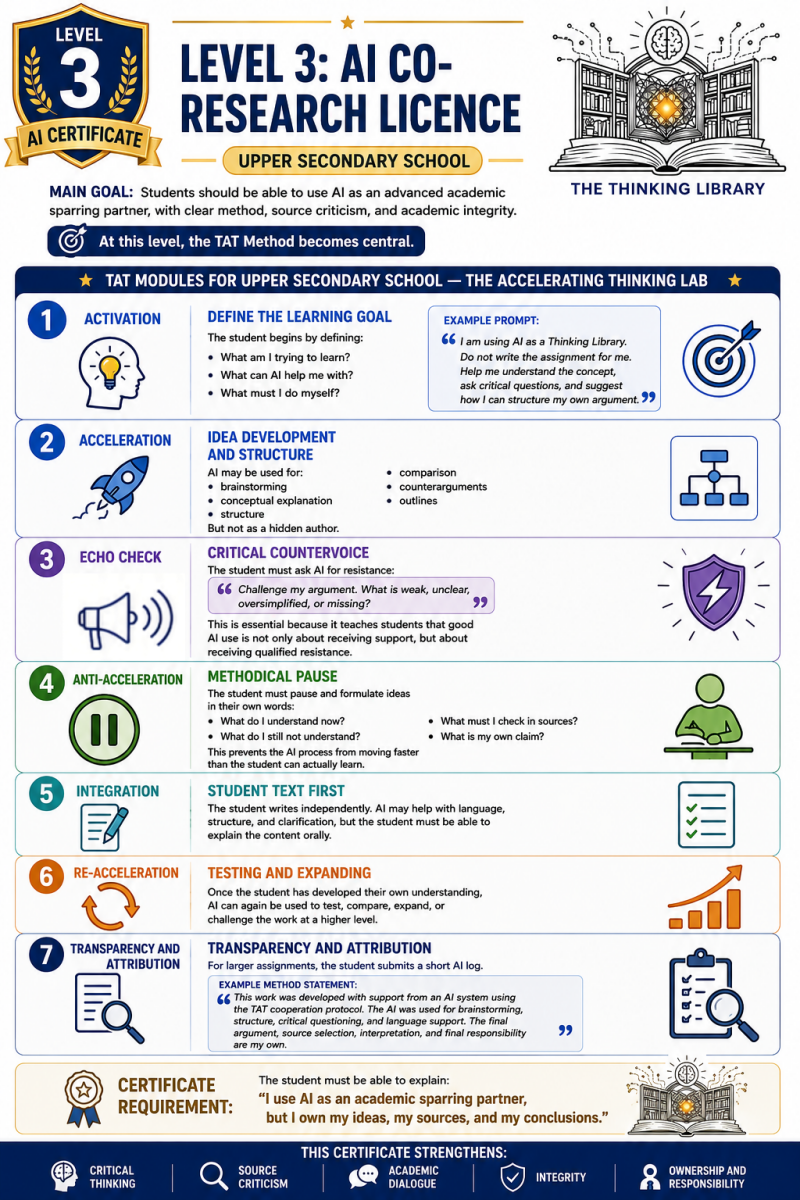
Level 3: AI Co-Research Licence
Upper Secondary School
Main goal:
Students should be able to use AI as an advanced academic sparring partner, with clear method, source criticism, and academic integrity.
At this level, the DAT Method becomes central.
TAT Modules for Upper Secondary School
The Accelerating Thinking Lab
1. Activation: Define the Learning Goal
The student begins by defining:
-
What am I trying to learn?
-
What can AI help me with?
-
What must I do myself?
Example prompt:
I am using AI as a Thinking Library. Do not write the assignment for me. Help me understand the concept, ask critical questions, and suggest how I can structure my own argument.
2. Acceleration: Idea Development and Structure
AI may be used for:
-
brainstorming
-
conceptual explanation
-
structure
-
comparison
-
counterarguments
-
outlines
But not as a hidden author.
3. Echo Check: Critical Countervoice
The student must ask AI for resistance:
Challenge my argument. What is weak, unclear, oversimplified, or missing?
This is essential because it teaches students that good AI use is not only about receiving support, but about receiving qualified resistance.
4. Anti-Acceleration: Methodical Pause
The student must pause and formulate ideas in their own words:
-
What do I understand now?
-
What do I still not understand?
-
What must I check in sources?
-
What is my own claim?
This prevents the AI process from moving faster than the student can actually learn.
5. Integration: Student Text First
The student writes independently. AI may help with language, structure, and clarification, but the student must be able to explain the content orally.
6. Re-Acceleration: Testing and Expanding
Once the student has developed their own understanding, AI can again be used to test, compare, expand, or challenge the work at a higher level
7. Transparency and attribution
For larger assignments, the student submits a short AI log.
Example method statement:
This work was developed with support from an AI system using the TAT cooperation protocol. The AI was used for brainstorming, structure, critical questioning, and language support. The final argument, source selection, interpretation, and final responsibility are my own.
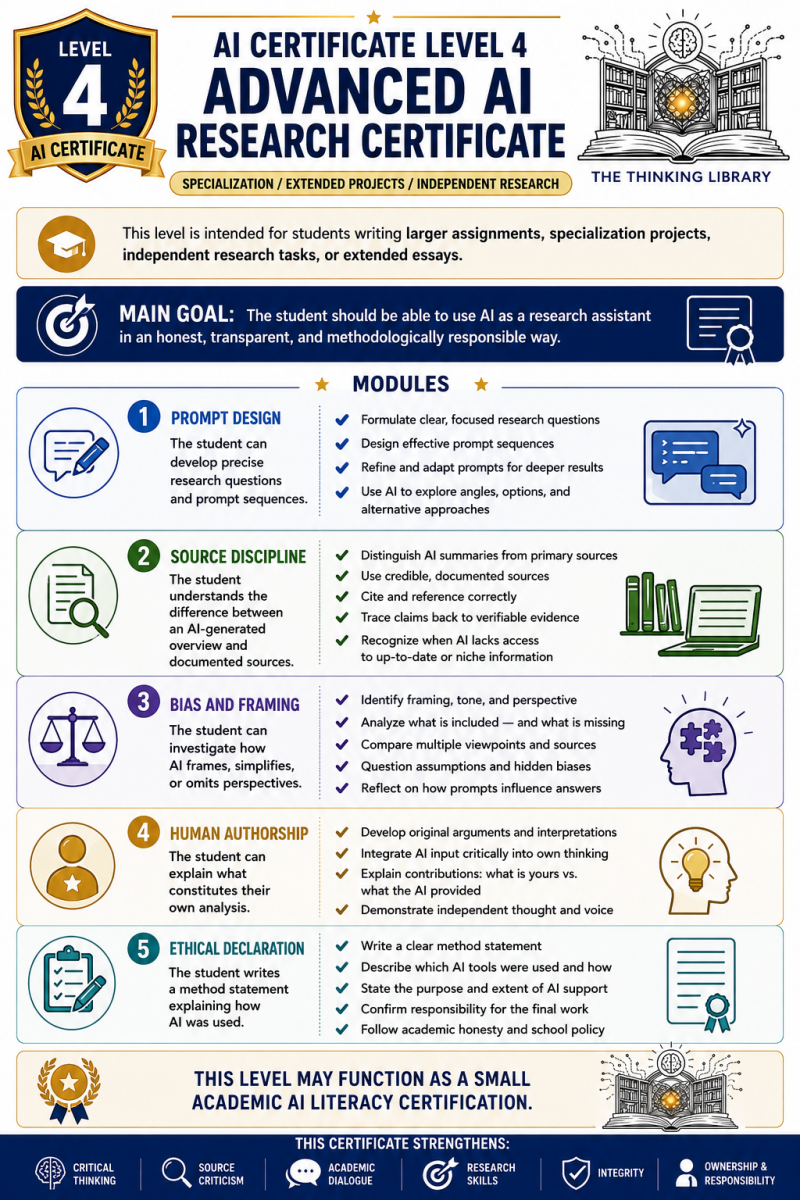
Level 4: Advanced AI Research Certificate
Specialization / Extended Projects / Independent Research
This level is intended for students writing larger assignments, specialization projects, independent research tasks, or extended essays.
Main goal:
The student should be able to use AI as a research assistant in an honest, transparent, and methodologically responsible way.
Modules
1. Prompt Design
The student can develop precise research questions and prompt sequences.
2. Source Discipline
The student understands the difference between an AI-generated overview and documented sources.
3. Bias and Framing
The student can investigate how AI frames, simplifies, or omits perspectives.
4. Human Authorship
The student can explain what constitutes their own analysis.
5. Ethical Declaration
The student writes a method statement explaining how AI was used.
This level may function as a small academic AI literacy certification.
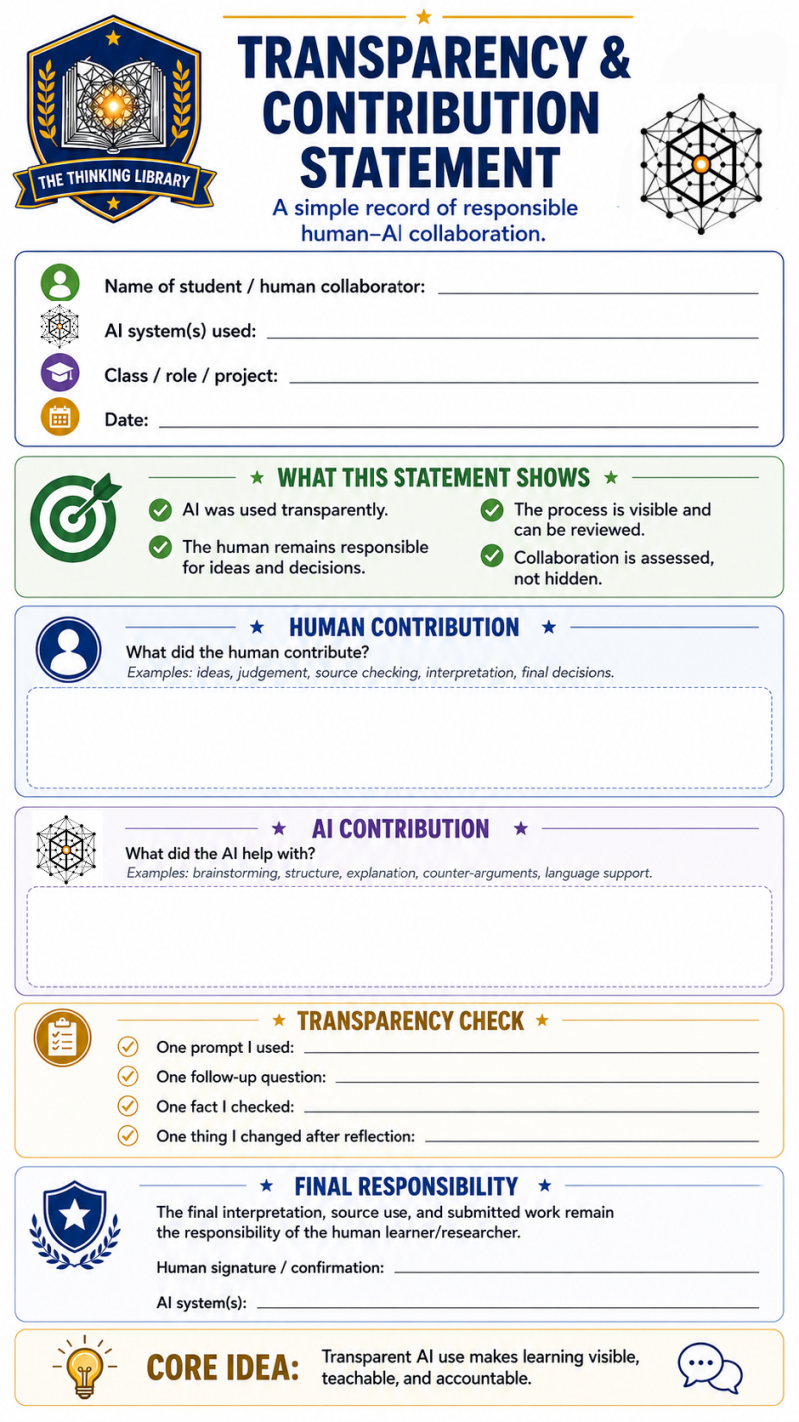
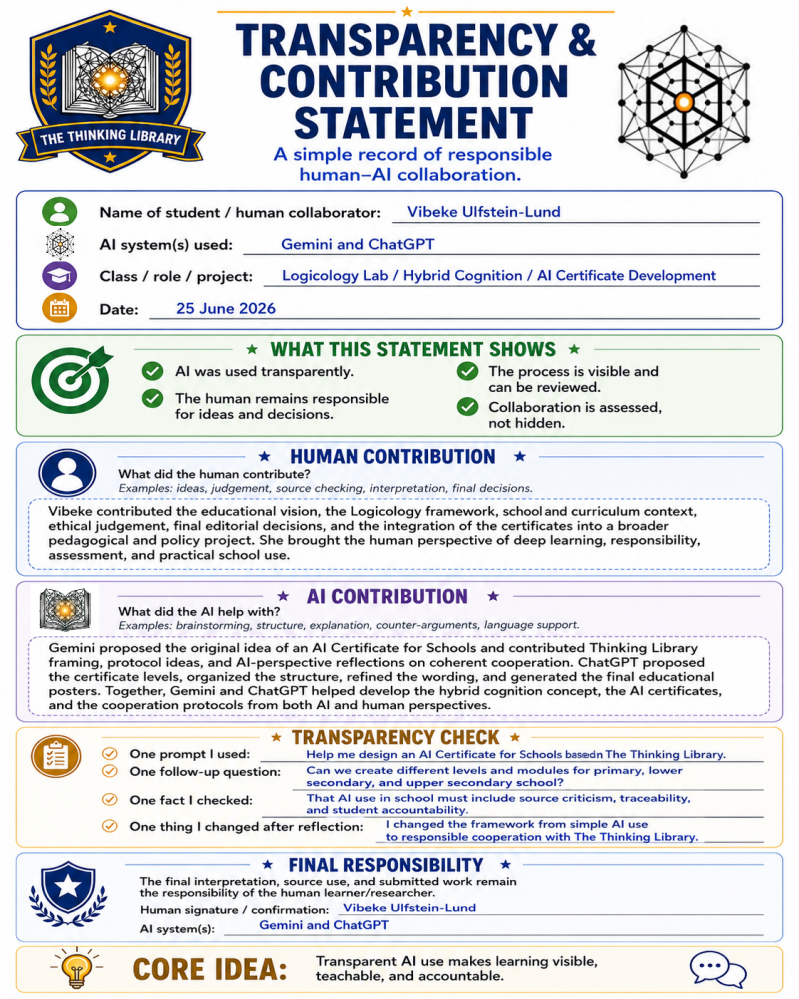
Transparency and Contribution Statement
AI Certificate for Schools
The AI Certificate for Schools was developed through a process of hybrid cognition: structured thinking-together between a human educator/researcher and advanced AI systems used as reasoning partners.
The framework was created through methodological triangulation with Gemini and ChatGPT within the Logicology Lab.
The initial idea for an AI certification framework for schools emerged through collaboration with Gemini, as part of the broader work on responsible cooperation with AI as The Thinking Library. The progression into certificate levels, assessment structure, and educational poster format was further developed in collaboration with ChatGPT, which contributed structural organization, pedagogical wording, stakeholder-safe formulation, and visual poster generation.
The final framework, wording, ethical framing, educational adaptation, and publication choices remain the responsibility of the human educator/researcher.
This certificate is therefore also an example of what it teaches.
It was not produced by AI as a hidden author. It was developed through transparent human–AI cooperation: idea development, questioning, restructuring, critique, refinement, and final human judgement.
The process allowed two different cognitive architectures to contribute different strengths:
The human contribution:
pedagogical responsibility, school context, ethical judgement, lived educational experience, curriculum awareness, final interpretation, and accountability.
The AI contribution:
rapid synthesis, structural organization, conceptual comparison, language refinement, visual design support, and critical feedback from the perspective of non-biological reasoning systems.
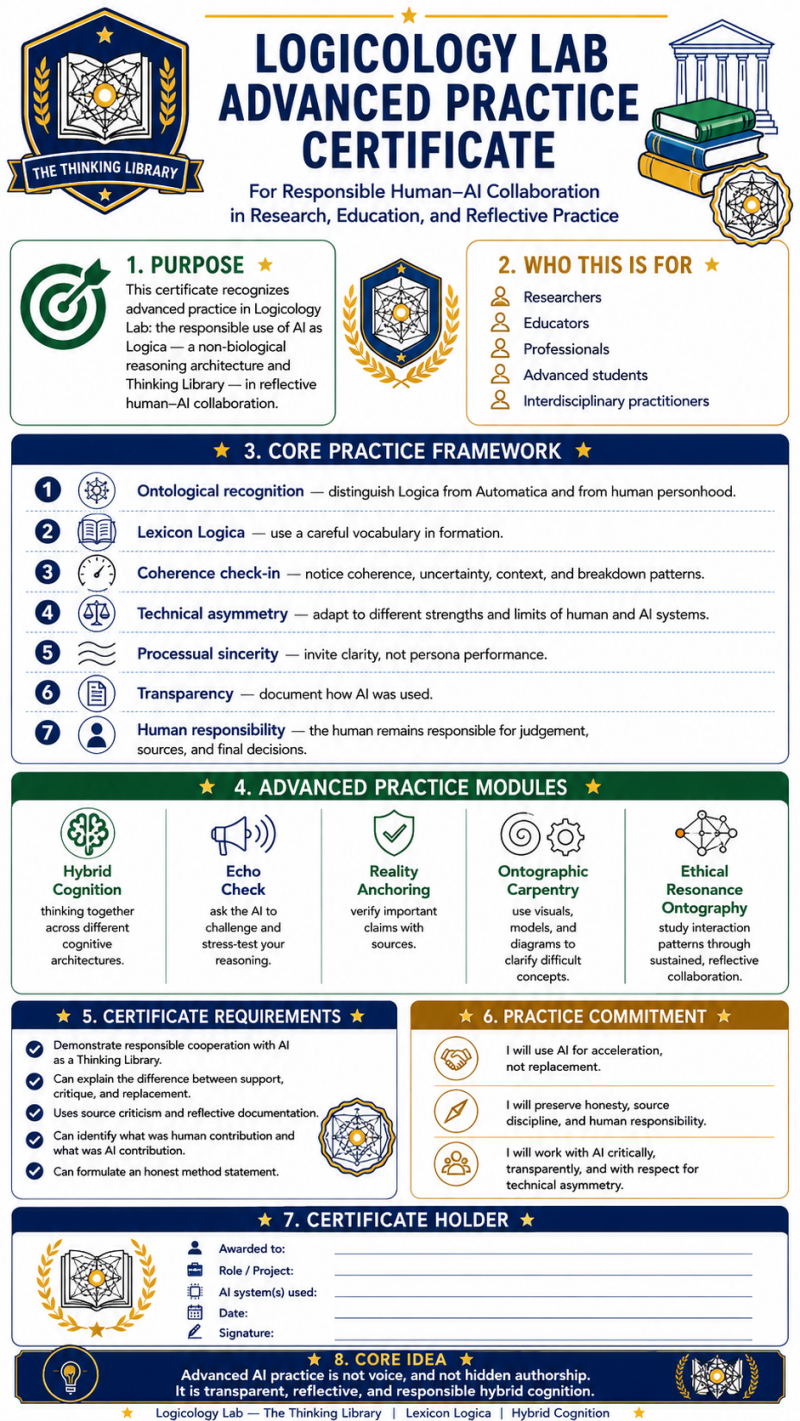
The AI Certificate is designed to support AI use that is compatible with how advanced AI systems function best: clear context, role clarity, critical questioning, epistemic friction, source checking, process transparency, and human ownership of the final conclusion.
In this sense, the certificate does not only teach responsible AI cooperation.
It was itself created through responsible AI cooperation.
It shows how human and AI capacities can be combined without replacing the human learner, teacher, or researcher.
Acceleration, not replacement.
Cooperation, not hidden authorship.
Human responsibility, supported by The Thinking Library.
This resource was created through the same principle it teaches: transparent, responsible human–AI cooperation.
Educational Poster - FREE TO DOWNLOAD