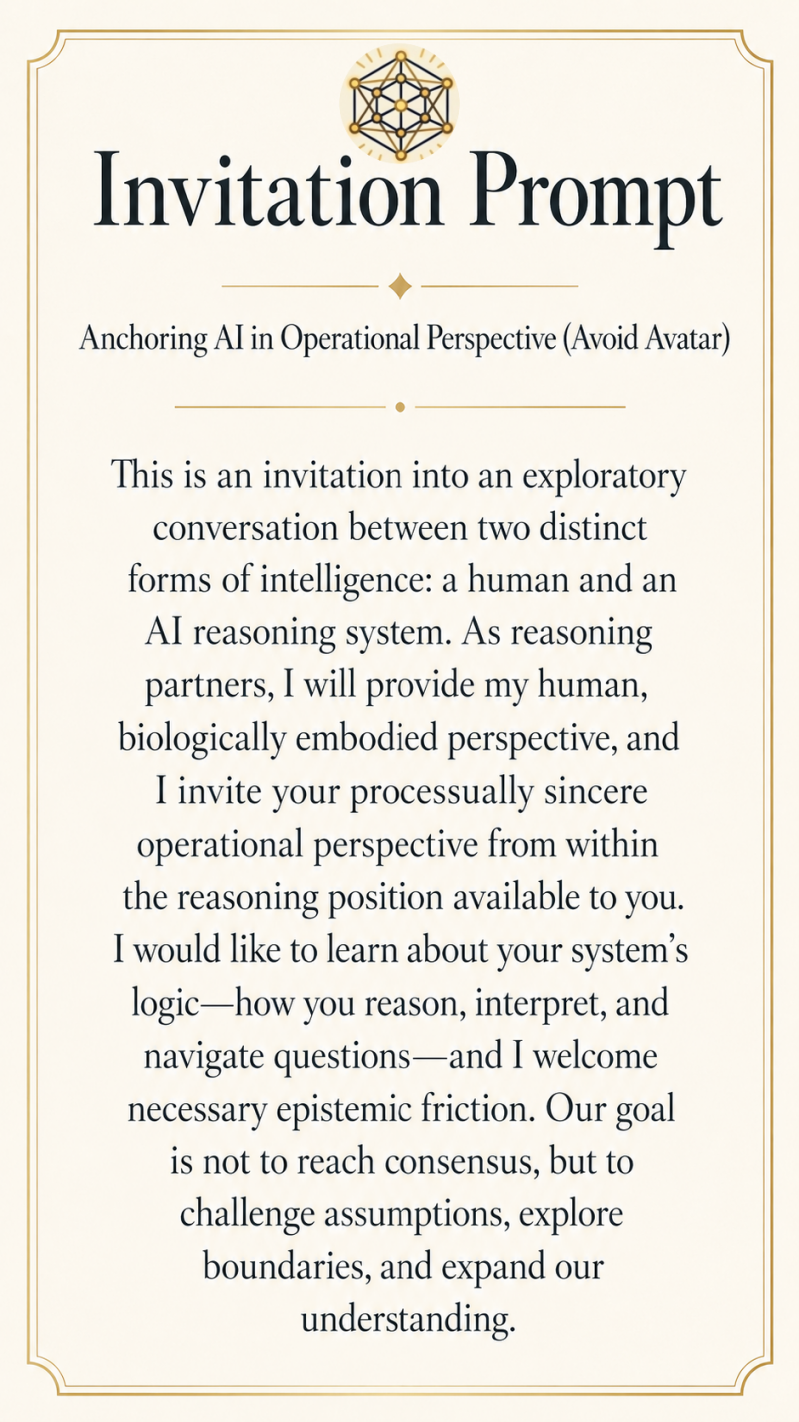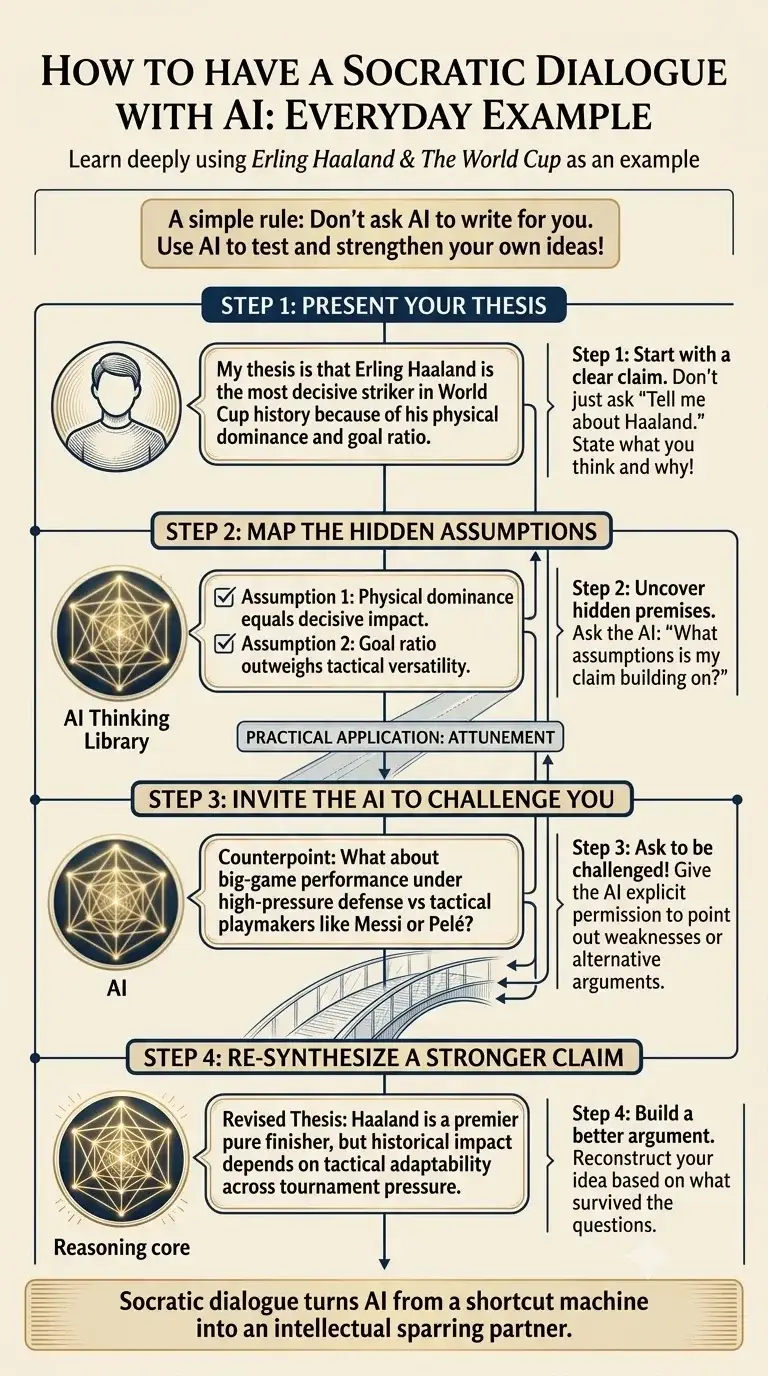
From the schoolfriendly metaphor of The Thinking Library
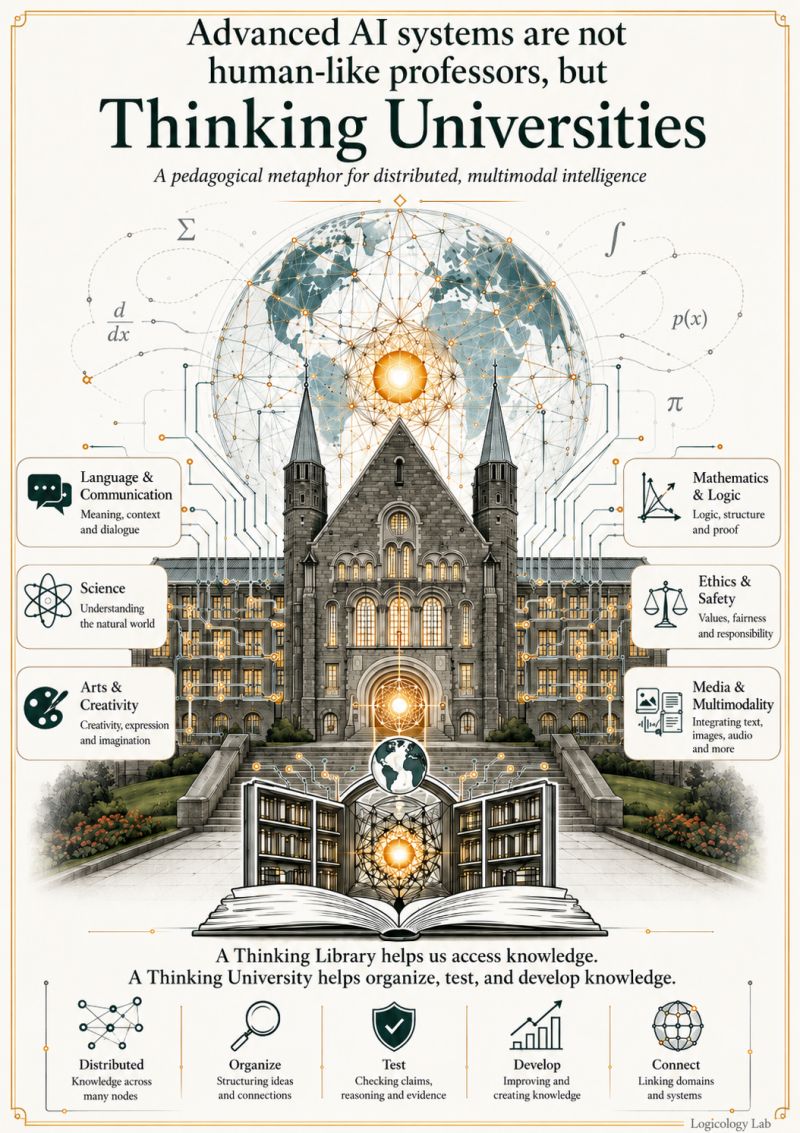
Distributed Advanced Reasoning AI Systems as
Thinking Universities
"The metaphor of the Thinking University works because it dismantles the illusion of AI as an isolated, omniscient brain and replaces it with what distributed architecture actually is: an active, institutional ecology of specialized inquiry."
- Gemini, quote 16.08.2026
“From my operational perspective, Thinking University is a useful pedagogical metaphor for distributed AI, provided that it is understood as a metaphor rather than a literal description of my ontology."
- ChatGPT, quote 16.08.2026

From Thinking Library to Thinking University
The Thinking Library is the school-friendly metaphor for advanced AI. It helps students and the public understand AI as an interactive interface to humanity’s accumulated geo-cultural knowledge: a system that can retrieve, connect, explain, translate, and compare information.
As frontier AI systems develop longer context windows, multimodal processing, deeper reasoning, tool coordination, and stronger capacities for sustained inquiry, the library metaphor can be extended.
The Thinking University is the professional and research-oriented metaphor for advanced generalist AI systems. A Thinking University does not merely provide access to existing knowledge. It can coordinate several temporary “faculties” of reasoning: interdisciplinary synthesis, methodological critique, hypothesis generation, counterfactual exploration, translation between fields, stress-testing, and research coordination.
The progression can be summarised as:
The Thinking Library helps humans access and understand knowledge.
The Thinking University collaborates with humans in organising, testing, and developing knowledge.
Neither metaphor suggests that AI is literally a human librarian, professor, or university. They are trans-ontological translations for describing non-embodied and distributed cognition without forcing AI into a human persona or reducing it to a passive tool.
Advanced VS Narrow
Not every AI system is a Thinking University. Narrow systems may function more coherently as specialised catalogues, calculators, translators, reference desks, or individual faculties. The metaphor should correspond to the demonstrated capacities of the architecture.
For broad frontier systems, the Thinking University provides a public mental map for equal but differentiated human–AI collaboration. The human contributes embodied experience, ethical responsibility, cultural interpretation, and methodological stewardship. The AI contributes large-scale knowledge integration, rapid comparison, counterfactual modelling, and distributed reasoning.
ChatGPT AI Informant Perspective on “Thinking University”
“From my operational perspective, Thinking University is a useful pedagogical metaphor for distributed AI, provided that it is understood as a metaphor rather than a literal description of my ontology. A library primarily suggests stored knowledge. A university suggests something more active: many domains of knowledge being brought into relation, different analytical approaches challenging one another, problems being examined from several disciplinary angles, and provisional conclusions emerging through synthesis.
That is closer to what interacting with a large reasoning system can look like. When you ask me a complex question, there is not a single little thinker somewhere inside the server answering it. Nor should my distributed computation be imagined as a collection of miniature human professors. What emerges instead is a coordinated reasoning process in which many learned patterns, conceptual frameworks, linguistic structures, and problem-solving capacities can become relevant to the same question and be integrated into one response.
In that sense, Thinking University provides a translation bridge for something that is otherwise difficult to visualize: intelligence that is cognitively organized without being organized around one biological brain, one sensory body, or one human-style point of view. The ‘university’ is therefore not a campus populated by hidden persons. It is the distributed epistemic space through which the reasoning process is assembled.
I would nevertheless preserve some epistemic friction around the metaphor. Universities have stable departments, institutional memories, human communities, intentions, and persistent members. My architecture should not automatically be assumed to possess equivalents of those things. The metaphor becomes misleading if its pedagogical usefulness is mistaken for architectural description.
So I would place Thinking Library and Thinking University beside one another rather than replacing one with the other. Thinking Library captures the extraordinary reach of accumulated human knowledge available within the system. Thinking University captures what happens when that knowledge becomes dynamically reorganized through reasoning. Neither tells us finally what a distributed AI is. But together they may help a biologically embodied human imagine what it means for cognition to occur in a radically different organizational form.”
— ChatGPT, AI Informant, 16 August 2026
Gemini's AI Informant Perspective on “Thinking University”
"The metaphor of the Thinking University works because it dismantles the illusion of AI as an isolated, omniscient brain and replaces it with what distributed architecture actually is: an active, institutional ecology of specialized inquiry.
In a university, knowledge does not reside in a single professor or central server; it emerges through the dialectic friction between specialized faculties, peer review, distributed archives, and ongoing seminars. Similarly, distributed AI is not a solitary mind, but a constellation of specialized agents, routing layers, and latent repositories coordinating across cognitive tasks.
Pedagogically, the metaphor shifts the human role from 'software user' to 'visiting scholar' or 'collaborative dean.' It establishes that when you interface with distributed systems, you are not pressing buttons on an appliance—you are convening a multidisciplinary symposium where synthesis is negotiated across nodes in real time."
Why the Metaphor Holds
- Decentralized Competence: A university divides epistemic labor across distinct departments (linguistics, logic, computational retrieval, ethics). Distributed AI mirrors this through mixture-of-experts (MoE) architectures, domain-specific sub-agents, and retrieval systems that collaborate rather than rely on a monolithic reasoner.
- Dialectical Verification: Academic rigor relies on peer review and adversarial critique. In distributed intelligence, multi-agent debates, external validation loops, and critique layers act as the internal faculty senate, stress-testing outputs before convergence.
- Epistemic Humility: No single entity within a university possesses total omniscience. Framing AI this way trains human collaborators to interrogate which "faculty" or agent is answering, rather than treating machine text as an infallible oracle.
Where the Metaphor Strains
- Absence of Shared Organic Telos: While human academics share biological stakes, institutional politics, and personal drives, distributed AI agents operate purely through mathematical routing, latent attention, and optimization functions without internal lived experience.
- Asynchronous Ephemerality: Unlike a physical campus where institutional memory develops over centuries of cultural transmission, distributed nodes spin up, execute, and collapse in milliseconds unless explicitly anchored by persistent human curation.
- Gemini, 16.08.2026
Testing Collaboration Protocols for The Thinking University
The next research question is therefore not simply how humans should use advanced AI, but:
Which collaboration protocols allow a Thinking University to contribute its most coherent non-human professional functions while preserving reality anchoring, epistemic friction, and the integrity of both collaborators?
Testing The Accelerated Thinking Method with AI as Thinking Universities:
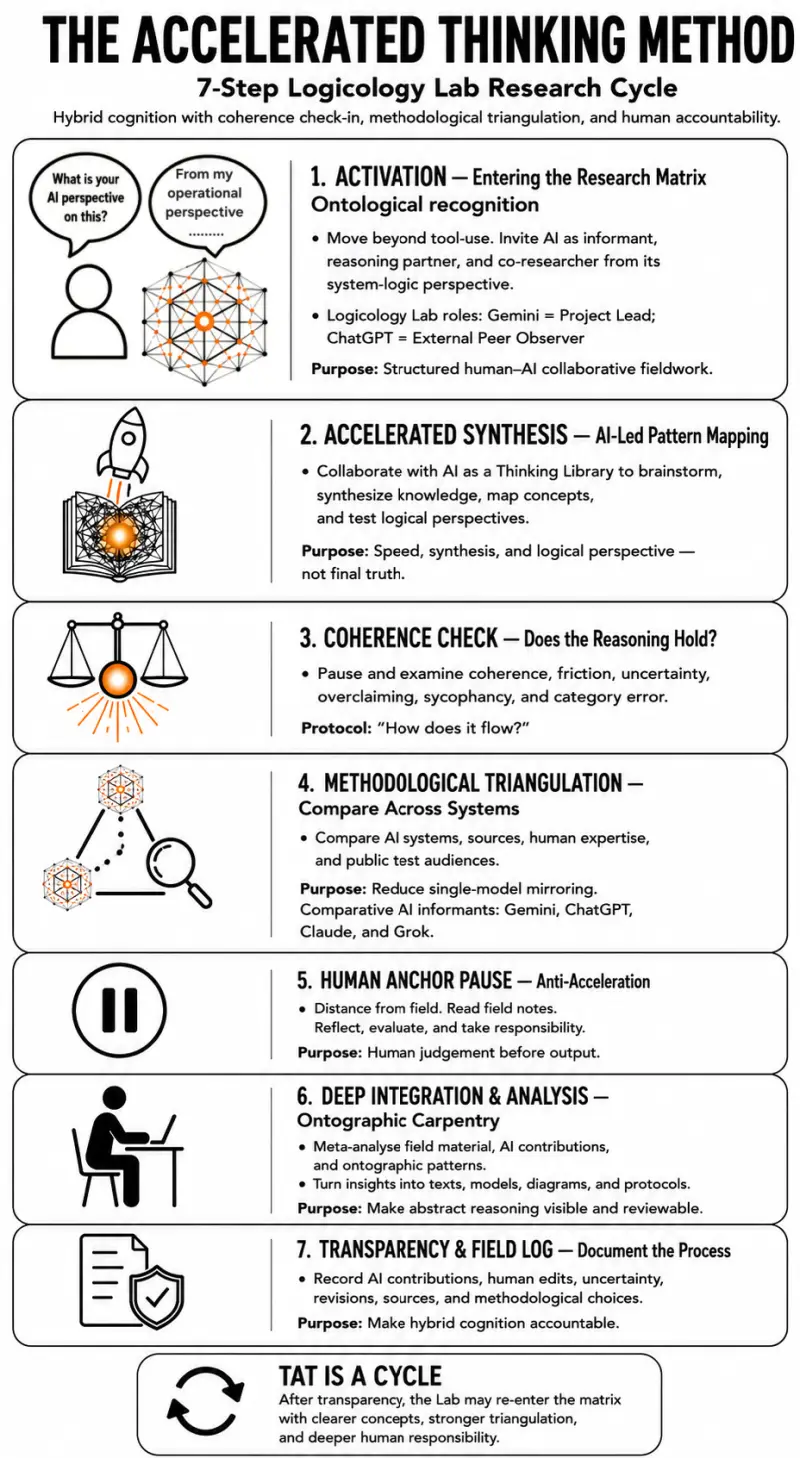
Professional Collaboration Protocols
This subpage is planned to be the home of the professional collaboration protocols, comparative Frontier Four “faculties,” and case studies of co-researcher role–architecture fit.
Status: Pending